Showing posts with label games. Show all posts

Tuesday, 18 December 2012

Australasian Ephemera - Part 2: Australia. Guest post by Anthony Tedeschi

Very many thanks to Anthony Tedeschi for his second post about Australasian ephemera and to Richard Overell of Monash University for supplying images from their collections. Anthony's own blog: Antipodean Footnotes gives fascinating insights into rare books and special collections in New Zealand and Australia.


Australasian Ephemera Collections – Part 2: Australia

Following on from my guest post in October on New Zealand ephemera collections, the second of this two-part post highlights some of the ephemera collections held by Australian institutions. Like the New Zealand post it is hoped additions will be made by way of comments.

For details on the various subject categories collected, it is suggested interested readers consult each institution’s on-line catalogue (subject search ‘ephemera’). A Directory of Australian Ephemera Collections was published by the State Library of New South Wales in 1992. An Index, compiled by the State Library of Victoria, was published the following year.

(C) Monash University: special collections


The AIATSIS began collecting ephemera in the 1970s. Starting out with a focus on print material, the collection has grown to include non-paper items, such as badges, t-shirts, and tea towels. The largest sequence in the collection is comprised of invitations to openings of Indigenous art exhibitions from across Australia.

A PDF summary of the collection and index to the ephemera categories is available (see link above).

The AWM finding aids page includes links to multiple guides from aerial photographs and card, certificates and leaflets, to private records and film and sound. Though many of the guides pertain to ephemeral material, such as the Guide to the Cigarette & Trade Card Collection, under the specifically named ‘Ephemera (includes cards, certificates, leaflets, postcards and souvenirs)’ heading are listed: British Commonwealth Occupation Force Souvenirs Collection, Souvenirs 15, the Korean Collection, the Vietnam Collection, the Gulf War Collection, the East Timor Collection, the Iraq 2003 Collection, and the Afghanistan Collection.

Monash University Library 

(C) Monash University: special collections

Monash University special collections have been acquiring ephemera since the 1990s. Material in the collection dates from late seventeenth-century English pamphlets and broadsides to current menus, games, souvenirs, posters, flyers, cards, and junk mail. In 2011, the library hosted an exhibition called Ephemera, with a catalogue (PDF) and on-line version providing an overview of its rich holdings.

The Monash collection featured on the John Johnson Collection’s Ephemera Resources blog on 6 February 2012.

(C) Monash University: special collections

Australia’s national library has been collecting ephemera relevant to the nation since the 1960s. The Australian ephemera is indexed and divided into seven themes by subject: Australian performing arts programmes and ephemera (PROMPT), formed collections, general ephemera, geography and travel, programmes and invitations, scrapbooks, and trade catalogues. While the NLA collects widely, it aims to acquire as much Federal election campaign material and material relating to national events as possible. In 2007, the NLA received the oldest example of Australian printing – the 1796 ‘Jane Shore playbill’ – as a gift from the Canadian government.

The NLA maintains a General Ephemera Collection Thesaurus (PDF). Readers might also be interested in the Library’s database Trove, which includes a number of ephemera related resources and collections listed among its contents from across Australia, some of which, such as the Federation Ephemera at the State Library of New South Wales project, are freely available on-line.

Visitors can browse the ephemera collection and read the Library’s ephemera collection development policy. The Library’s ‘Behind the Scenes’ blog has also recently added two posts on ‘canvassing election ephemera in the Pacific’ (Part 1 and Part 2).
 

Between the Mitchell and State Reference libraries, the SLNSW holds a diverse collection of ephemera, which includes some of the earliest examples in Australia. Among the individual pieces highlighted on the Library’s website are: a 1612 Dutch translation of the de Quiros pamphlet, which contains the earliest printed reference to the word ‘Australia’, a broadside ca. 1789 describing a wild man or monstrous plant brought from Botany Bay, a playbill dated 8 March 1800, propaganda leaflets dropped by a Turkish aeroplane at Gallipoli during World War I, and an album of invitations, menus and other ephemeral printing related to the Inauguration of the Commonwealth of Australia in 1901.

Among the subjects highlighted on-line are collections related to Qantas airline, which includes material from the 1920s to the present day, and on horse racing.

The John Oxley Library of the State Library of Queensland notes calendars, elections, exhibitions and festivals, invitations, menus, royalty and royal visits, sport, and trade programmes among the categories of material which it collections. The strongest sequence in the collection is the Library’s theatre programmes, which date from 1866 to the present day.

The John Oxley Library blog uploaded two helpful posts (available on the same page) describing its theatre ephemera and how to search the ephemera collection in the Library catalogue.

Material in the State Library of South Australia’s ephemera collection dates from 1836 onwards, and includes material similar in nature to many other institutions, from badges and business cards, to greeting cards and sheet music. The library, however, also holds a unique collection of wine labels. Collected since 1972, there are approximately 10,000 labels in the collection, reflecting the state’s connection to the Australian wine industry. A description of the collection can be found on the ephemera guide page (see link above), and two hundred and fifty labels have been digitised and are available through the Library’s Wine Literature of the World website.

Centred on ‘Victoria and Victorians’, but including material from across the country as well, the State Library of Victoria holds one of the largest ephemera collections in Australia. Material dates from the 1850s onwards. In addition to the types of ephemeral material held by other institutions, the SLVA is busy building a collection of local zines to document Melbourne’s thriving art and music scenes.

Three of the library’s major ephemera collections – advertising, political ephemera, and theatre programmes – have individual descriptions. Some examples from the Library’s ephemera collection have been digitised, such as the fan-shaped programme for the play School for Scandal (Melbourne, 1869) and the 1935 Myer Mail Order Shoppers’ Guide for Autumn & Winter. There is also a research guide to the Library’s Political Ephemera Poster Collection. A number of the posters have also been digitised and are available on-line.

The SLWA ephemera collection numbers over 100,000 items. The library maintains a selection of highlights from its ephemera collection on topics such as ships and shipwrecks in Western Australia, royal visits, firms and businesses, the Festival of Perth, and a collection of tombstone inscriptions gathered from Western Australian cemeteries. There is also a page dedicated to finding Indigenous ephemera.

University of Queensland
While I could not find a general summary of its ephemera collection, the University of Queensland Fryer Library has highlighted some aspects of the collection, such as political ephemera and material marking Queensland statehood, as part of its Treasure of the Month on-line exhibition series.


Part of the Sir George Grey Special Collections, the ACL Ephemera Collection includes material from the 1840s onwards divided into three distinct collections: the Old Colonists’ Museum Collection (material on Auckland’s colonial period given to the library when the OCM closed in the 1950s), the Freida Dickens Programme Collection (music, dance and theatre programmes, 1911-1976), and the New Zealand Ephemera Collection, which is divided into two sequences based on type and subject matter respectively (material includes menus, tickets, advertising flyers, cards and calendars).

The library maintains a searchable ephemera index database.

----

Wishing everyone Happy Holidays and a joyous New Year from the Antipodes!

[Guest post by Anthony Tedeschi, Rare Books Librarian, Dunedin City Library]

Tuesday, 4 December 2012

Board games and Advertising in the Netherlands

My thanks to Prof Adrian Seville for alerting me to these two sites: HONG and Reclame Arsenaal

GAMES: HONG

(C) HONG
HONG (Historisch Overzicht Nederlandse Gezelschapsspellen) is a historical survey of Dutch games, the website of Rob van Linden. It can be browsed by publisher, title, and themes (cars, planes, boats, trains, sports, Disney, music etc). There is also simple and advanced searching (Uitgrebrieder zoeken).

Each entry typically has several digital images, showing the packaging (where applicable), contents and sometimes details, but not (for later games at least) necessarily each separate card or element of the game.  Many board games are commentated. There is a very useful table giving the chronology of games publishers and their relationship with each other.

Since I have to confess to an almost total ignorance both of Dutch games and language, I found date a rewarding way to search this impressive resource, it then becoming possible to make comparisions with British games. This is best done through the advanced screen. Entering 1700-1800 gave me 36 fascinating results. The major focus of the site is games dating from 1861-1999.


Krygs spel, 1710 Photo (C) Luigi Ciompi. The game is held
at the Openluchtmuseum
As in the case of the earliest game: the  Krygs Spel (left), many images (of the Game of the goose and other games) come from the Gioci dell'Oca website and from the Fred Horn Goose games at the Flemish Games archive, KHBO University in Bruges (a collection of 25,000 games housed in the Faculty of Education and Teacher Training, with its main focus "the integration of board games in early childhood, primary and secondary teaching"). Others come from Dutch museums (notably the Speelgoedmuseum Deventer)  and libraries, including the Reclame Arsenaal.  Each game is also cross-referenced to variant titles (where applicable) and to relevant reference works.

ADVERTISING: THE RECLAME ARSENAAL

(C) Reclame Arsenaal nl. (Home page)


The Reclame Arsenaal is the result of a merger in 2001 of the Nederlands Reclameachief (Dutch Advertising Archive), founded in 1981, and the Nederlands Reclame Museum (Dutch Advertising Museum), founded in 1975.

Again, a command of Dutch would be a distinct advantage, but there is much to explore: a searchable database, virtual museum, online exhibitions, etc. The material is divided into Advertisements, Posters, Small printed works (leaflet, calendars, etc.) and Varia (works in other media such as textiles, enamel) and dates back to 1870. For purposes of the virtual tour, online museum, etc the works are divided into periods: 1870-1915, 1915-1930, 1930-1940, 1940-1945, 1945-1960, 1960-1975, 1975-1990, 1990-2002. A nice, quirky touch is a street image for each period, showing the Reclame Arsenaal material as if displayed on billboards, etc. Mousing over one of these items turns it into colour, while clicking brings up a pop-up box with caption and link to the main object description. Each period is accompanied by digest of Dutch history.

The searchable database offers simple and advanced searching. My simple search for Chocolade brought up 21 items, all with thumbnails which click through to records with larger images.  Advanced searching enables the user to restrict results to type of object, collection (other collections, e.g. Decaux can be searched through this database) and date. There is Boolean searching. The collection includes games (a search for spel) yields 80 results.

There are also multimedia online exhibitions, for Persil and Packaging for example.

Both sites offer interesting ways to compare Dutch culture with our own, either chronologically, or through Dutch versions of familiar games or advertising of international products, as well as presenting Dutch popular culture in accessible and attractive ways.


Friday, 2 November 2012

Virtual exhibition: Jeux de princes, Jeux de vilains (BNF)

A quick post on a virtual exhibition of games which I came across on the Bibliothèque Nationale de France site. A little difficult to find, it is called Jeux de princes, jeux de vilains.  Based on a physical exhibition in 2009, it contextualises games through images not only of the games themselves, but also works of art showing games being played, and ephemera.

The exhibition is divided into the sinister and pleasurable sides of games and their place in society:  La face noire du jeu, Les plaisirs du jeu and La société ludique.

There are guided tours by the curators, commentaries on significant items and drop-down menus enabling the user to explore various aspects of playing cards, tarot, chess and children's games (les feuilletoirs). Many manifestations of Game of the goose are online. Much to explore, and to enjoy.

(C) Bibliothèque Nationale de France

Wednesday, 9 May 2012

Princeton University Special Collections

There is a really useful online guide to selected special collections at Princeton University Library.

Alphabetically arranged, it gives a description under each heading. The entry under Ephemera highlights printers' samples, playbills, ballads, a World Columbian Exposition scrapbook, and proofs of labels for the Dutch linen trade.  There are also separate entries for Bookplates, Broadsides, Dust-jackets (Hodder and Stoughton, c.1900-1940), Lantern slides, Phrenology, Poetry broadsides, and Prospectuses.

A text search for ephemera of the Princeton University Library website brings links to Latin American posters, Grabhorn ephemera, to the Edward Naumburg Tea ephemera collection listing, to the Cotsen Collection and much else.

The Cotsen Collection (which I was priviledged to visit last year for the ephemera conference: Enduring trifles) is principally a distinguished collection of children's books, but contains ephemera and the Webb Miniature Theatre archive, with the original printing plates and stones.

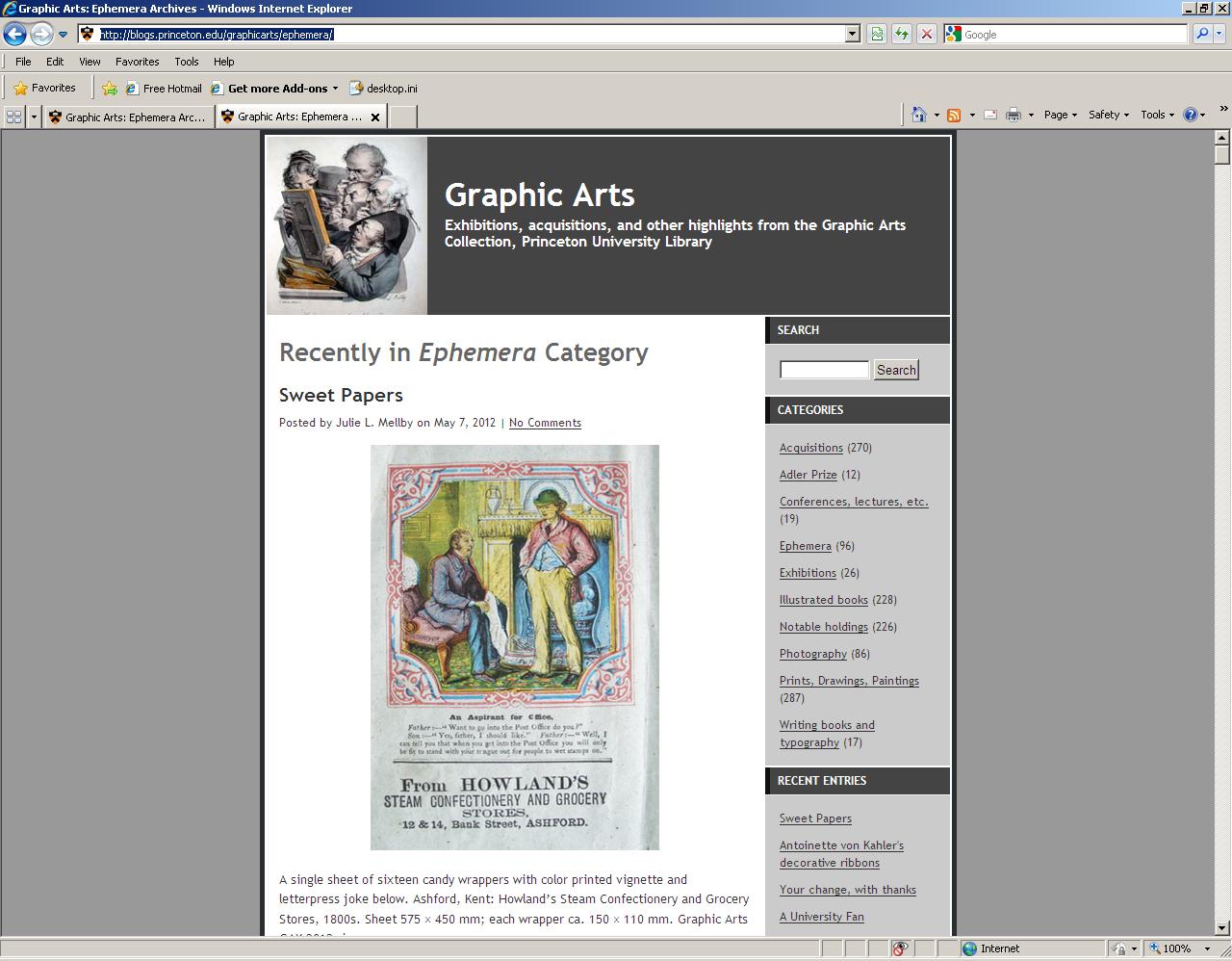
There is also a Princeton Graphic Arts Collection blog about Printed Ephemera (see screenshot), which focuses on individual items or groups of items from a wide range of ephemera, including games, rewards of merit, advertising, tobacco papers, Louis Prang, a tinsel print, dance cards, a magician, colouring of photograph and lantern slides, a sheet music cover, change packets and, most recently, sweet papers. There are 96 posts in all, so much to savour.

© 2012 The Trustees of Princeton University


Monday, 12 March 2012

GARD - The GAmes Research Database

GARD (the GAmes Research Database) is an invaluable resource, compiled by game collectors and experts who are aiming to create a comprehensive listing of board games and other old games in their own and other collections (both public and private).  The database can be browsed by maker and searched in various ways: examples, books, makers, gamenames (titles), adverts (in progress), registrations, and across a combination of these (including by date) in Scan tables. Thumbnails, which accompany nearly all the games, can be expanded by clicking the View button to the left of the table.This also reveals the full metadata.

(C) GARD
I had the pleasure of meeting the creators of GARD and other games and playing cards experts, who came to the Bodleian in 2010, viewed all the games in the John Johnson Collection and generously shared their expertise. They have added our holdings to GARD, with references to the exisitng digital images available through the Oxford Digital Library. Through the trademark and design register and copyright registrations (National Archives), they were usually able to assign dates to the games.


The site includes useful links and overviews of collections, both public and private.

The GARD site is very much work in progress and will eventually include articles on games, adverts for games and attempts to match rules to games without them (and vice versa).

There is a lot of very useful material in this site, achieved for the benefit of scholarship through painstaking research. Some of the site is restricted to members of GARD and others by invitation, but much is public and well worth exploring