Showing posts with label Ephemera (American). Show all posts

Thursday, 10 April 2014

American Advertising

The Art of American Advertising 1865-1910 is an exhibition at the Baker Library of the Harvard Business School. Drawing extensively on its historical collections, the exhibition takes an analytical approach to the use of art in relation to its themes:: National Markets, Advertising Products, Trade Catalogs, Trade Cards, Souvenirs & Novelties, Scrapbooks & Collectibles, The Art of 'Posting',  Brand Name Management, and A Marketing Revolution.

The online version is extensively  illustrated and can be seen either as a series of illustrated essays, or as galleries.

(C) Harvard Business School. Baker Library

Meanwhile, the Winterthur Museum Library has impressive online content relating to its advertising collections, with thousands of images. The numbers attached to the suggested searches speak for themselves. This is a very rich resource: Book industries (83), Clocks and watches (328), Clothing and dress (235), Department stores/Dry goods (173), Food (261), Furniture (492), Jewelry (414), Medicine (187), Music (156), Pottery (59), Sewing (234), Stoves (114), Tobacco (149), Advertisements (125), Poster stamps (1840), Trade cards (4018), Textile fabrics (94).


There is more: much more: images of Bookplates, French candy wrappers, Funeral and Mourning Ephemera (the William Frost Mobley Collection), Indentures, Lantern Slides, and 171 calendars and 295 cigar labels from the Grossman Collection. The image quality is outstanding, with zoom enabling every detail of the printing process (chromolithography in the case of the Grossman collection) to be studied.

All collections have overviews, outlining their extent and scope. The Grossman Collection, which I was privileged to see many years ago in California, has c. 250,000 items of high-quality ephemera.

I also particularly like the click-through facility in all fields, which enables you to see images of trellis, for example, across the collections.

As described in a previous post, more than 900 trade catalogs are available through the Internet Archive.

Content is continually being added and subscriptions to RSS feeds are available at collection level.


Wednesday, 19 March 2014

American Antiquarian Society update: GIGI

Since my post in January 2012, the American Antiquarian Society has launched its Digital Image Archive, called GIGI with beautifully presented tif-format thumbnails. This is in addition to other stand-alone digital projects and online exhibitions. Of particular interest to ephemerists are the 1415 broadsides (Browse and select broadsides).  A keyword search for ephemera yields 3018 results at the time of writing (of 10,000 results from a keyword search in the General Catalogue). There are links from the catalogue into GIGI where appropriate, so the advice to scholars is to start there.

All very exciting for those of us who don't have Readex and want to browse the collections of the AAS.   There is advanced searching too within GIGI.


Search for broadside in GIGI (C) American Antiquarian Society
A list of collections represented includes the following categories of ephemera:
Album cards; Billheads; Broadsides; Christmas cards; Civil War envelopes; Currency; Election Ballots; Invitations; Membership Certificates; Menus; Postcards; Ream Wrappers; Sheet Music; Trade Cards; Valentines; and Watch papers from Graphic Arts, and Trade catalogs from Books. There are also hundreds of prints.

The AAS blog also has posts about ephemera (e.g. the recent post about Irish ballads for St. Patrick's Day) and a very active Twitter account: @AmAntiquarian

Friday, 14 June 2013

Ephemera exhibitions, catalogues and books (1)

There are currently several ephemera exhibitions, in this country and in the U.S.A.

This week, I went to The London Transport Museum's Poster Art 150: London Underground's Greatest Designs. Superb posters, with a public voting system to select the most popular poster. The exhibition is arranged into themes:: Finding your way, Brightest London, Capital culture, Away from it all , Keeps London going and Love your city.  There is a catalogue, reproducing the posters. The exhibition runs until 27 October.

The British Library has a major exhibition: Propaganda: Power and Persuasion (17 May to 17 September).

Propaganda: Power and Persuasion home page: (C) British Library Board

There are events, tours, a blog and a catalogue by Prof David Welch.

In the USA, the exhibition Ephemera: the art of everyday printed mattter has just opened at the Portsmouth Athenaeum and runs until  15 September.

(C) Portsmouth Athenaeum
The Library Company of Philadelphia (the subject of previous blog posts: 13 Feb 2012 and, guest post by Erika Piola, 29 June 2012) meanwhile has an exhibition Remnants of everyday life: historical ephemera in the workplace, street and home, which runs until 15 December 2013.

There is also a related ephemera conference: Unmediated history, the scholarly study of 19th century ephemera (Visual Culture Program of the Library Company of Philadelphia and Ephemera Society of America) at the LCP  from 19 to 20 September 2013.

While I could not find any links to exhibition catalogues for either USA exhibition, this is a good chance to promote the Library Company of Philadelphia's recent project: Philadelphia on Stone, which has an online exhibition, digital catalogue and a major publication: Philadelphia on Stone: Commercial Lithography in Philadelphia, 1828-1878, edited by Erika Piola.

Finally, a new, scholarly book on ephemera has just been published. Studies in Ephemera: text and image in eighteenth-century print, ed. by Kevin Murphy and Sally O'Driscoll, Lewisburg (Bucknell University Press) focuses mainly on ballads (including a chapter on ballad images by the Bodleian's Alexandra Franklin) and broadsides.  There are also chapters by Sally O'Driscoll on macaronis in print culture and  by Georgia Barnhill on Ephemera at the American Antiquarian Society: perspectives on commercial life in the long eighteenth century.  The superb ephemera in the AAS have been digitised and are available to subscribers only through Readex. Sadly, the Bodleian does not subscribe.

Studies in Ephemera is also widely available as an e-book

Wednesday, 13 February 2013

Valentines: more resources

It is valentine season again and time to highlight collections both here at the Bodleian and elsewhere.

This year, I have joined with the National Valentine Collectors Association to focus on the valentines of Eugène Rimmel.  My own contribution is a small virtual exhibition about Rimmel's advertising and his association with the Theatre on my blog: The John Johnson Collection Now and Then.  Nancy Rosin has devoted the winter issue of The Valentine Writer (the journal of the National Valentine Collectors Association) to an excellent article on Rimmel (available as a pdf) and Malcolm Warrington has created a beautiful online exhibition.  There are also posts about Comic valentines (and the 200th anniversary of De La Rue) on the UK Ephemera Society's Facebook page.


Also from the other side of the Atlantic, many thanks to Nancy Rosin for recommending The Virtual Museum of Canada, which has a virtual exhibition:  Valentine's Day:  love and romance through the ages, complete with the facility to open and rotate three-dimensional pop-up valentines (in QTVR files) and to create and send valentines from a museum object, card or artefact  for electronic delivery.  A lot of fun, but also solid information about the history not only of valentine cards, but of other love offerings.There are 1229 hits for valentines from various Canadian institutions in the image gallery.

(C) Virtual Museum of Canada


Back in Britain, The Museum of London has put online 1788 valentines, manufacturers' sample sheets and related material, mostly from the prestigious Jonathan King Collection. Jonathan King was a valentine maker in Essex Road, London and this collection gives a wonderful and invaluable insight into the manufacturing process. As well as complete valentines, there are proofs with annotations made in the workshop, relating to design and price, stock number etc. Each item is captioned and dated.  There is also a blog: The more unusual valentines in our collection.

(C) Museum of London

 The Discover pages of the (new) Library of Birmingham include introductions to the history of valentines, and to Comic valentines, with two galleries featuring sentimental and comic cards from their collections.  Similar pages are devoted to Birthday cards, Greetings cards illustrated by Kate Greenaway, Silk embroidered postcards, First World War song cards, and Miscellaneous greetings cards.

(C) Library of Birmingham

Hull Museums also have a large collection of valentines.

(C) Hull Museums


(C) The British Postal Museum & Archive


The British Postal Museum and Archive has a fascinating online exhibition Passion through the post highlighting its collections and outlining the history of the valentine, from the perspective of the postal historian.Their valentines are catalogued, with 892 hits for a  simple search for valentine, some accompanied with thumbnail images.


Tuesday, 23 October 2012

The Philip & Rosamund Davies US Elections Campaigns Archive: Guest post by Jane Rawson

This guest post by Jane Rawson is from the blog: US Studies Resources at Oxford   re-posted with permission


The Philip & Rosamund Davies US Elections Campaigns Archive


The Vere Harmsworth Library is home to the Philip & Rosamund Davies US Elections Campaigns Archive, an extensive collection of campaign ephemera from American elections at all levels. The archive has been donated to the library by Professor Philip Davies, Director of the Eccles Centre for American Studies at the British Library, and is the result of many years of active collecting. The majority of the material dates from the later 20th century, but there are examples of older items dating back as far as 1840. The archive continues to grow as Professor Davies collects and donates material from each new round of elections in the United States.

The archive has now been fully catalogued and can be made available to researchers in Oxford. While items such as those contained in the archive were intended to be ephemeral at the point of production, they can tell researchers a great deal about the campaigns and candidates they were produced to support (or indeed protest). They are physical evidence of the issues on which campaigns were fought, and the perceived strengths and weaknesses of the candidates who fought them. Not just the literature, but the slogans and design of buttons, posters and bumper stickers, as well as the very items branded for campaigns indicate the way candidates chose to present themselves and their opponents. As well as providing insight into the campaigns themselves, the literature and artefacts contained within the collection also demonstrate wider developments in society, politics and technology.

A century of presidential campaign buttons, 1908-2008

What does the archive contain? 
  • Thousands of buttons for hundreds of candidates, the oldest dating from 1840
  • Bumper stickers and posters
  • Ballots for elections from a wide range of locations and dates, the oldest dating from the Civil War
  • Campaign leaflets and other literature for elections at all levels, from local to presidential
  • Protest and negative material
  • Election, convention and inauguration memorabilia, such as commemorative plates, medals, mugs and other souvenir items
  • And all sorts of campaign branded items such as hats, t-shirts, jewellery, dolls, playing cards, rain bonnets... even a bar of soap!
To learn more about the archive and what it can tell students and researchers of American history and politics, watch the below video of Professor Davies discussing the material culture of US elections and political marketing, accompanied by selected items from the collection.


There have also been a couple of short videos on the topic posted recently on the BBC website in the run up to this year's elections: Badge man predicts Ohio winner, talking to a manufacturer of campaign buttons, and Preserving US presidential campaigns on the web, which visits the Smithsonian's extensive collections as well as looking at the archive of campaign TV advertising from the Museum of the Moving Image.

Full details of the materials can be found in the archive catalogue, and images of some of the items (either individually or as part of previous exhibitions) can be seen on our Flickr page. If you are interested in consulting items from the archive, please contact jane.rawson@bodleian.ox.ac.uk.

Friday, 29 June 2012

Explore More Ephemera Collections at the Library Company of Philadelphia: guest post by Erika Piola


I am so pleased to guest post an update about the Library Company of Philadelphia’s ephemera collections first described on February 13, 2012. Thanks to the generosity of the National Endowment for the Humanities, more of our printed and graphic ephemera is now available online. Those with an interest in popular and visual culture, history of women, German-Americana, and economics now have access to near 30, 000 pieces of ephemera as well as over 7,000 representative digital files of these holdings in our catalog ImPAC.

(C) Library Company of Philadelphia

Ranging in date from circa 1720  to circa 1900, and arranged by genre and/or provenance, our newly accessible materials include early 18th-century bills of lading; amateur newspapers;  postcards, stereographs, and trade cards documenting Philadelphia cityscapes, businesses, and commercial customs; and a number of personal and professional albums and scrapbooks. Within the latter, the works of early prominent local photographers, specimens compiled by 19th-century Philadelphia printers and engravers, as well as trade cards, souvenirs, and mementos collected by socialites of the Progressive Era can be found. Other ephemera documents the Centennial Exhibition of 1876; the history of the Library Company; and the work of artist Peter Moran.

(C) Library Company of Philadelphia

w
(C) Library Company of Philadelphia
  
The grant funding also facilitated the cataloging and digitization of materials given by contemporary collectors and long-term donors. The Helen Beitler Collection contains items predominantly related to 19th-century advertising, including billheads, blotters, calendars, envelopes, and labels. The collections given by William H. Helfand, a Library Company trustee emeritus and retired drug company executive, are a rich source for the history of patent medicine. The Roughwood Collection given by folklore scholar Don Yoder and William Woys Weaver document the lives of the Pennsylvania Dutch, while the Michael Zinman collections shed light on international communities through his World’s Fairs Collection, the blind community through his raised letter publications,  and the legal community through his collection of pre-1801 blank forms, such as subpoenas, deeds, and court summons.

More esoteric materials are also represented. Patrons can peruse Philadelphia amateur scientist Joseph Breintnall’s nature prints of leaves, one of our earliest acquisitions of ephemera, given to the library in 1746; circa 1895 color-printed flash cards to teach foreign languages through the Berlitz Method; as well as “Things Found in Books” from within our holdings.

Although several of the collections noted above are viewable in the digital catalog, additional and complementary records describing the materials can be further discovered in our traditional catalog WolfPAC. Through search terms representing the genre of the material, the collection or collector’s name, or the grant funder “National Endowment for the Humanities,” catalog users have another method in which to learn about the diversity of the Library Company’s ephemera collections.

I hope I have inspired a few more ephemera enthusiasts and scholars to visit our collections online (and in person). And one final note - please do not assume that a collection retrieved through a hyperlink is the only digital collection represented by the text highlighted. Please explore ImPAC. More ephemera of interest is sure to be found.

Erika Piola
Associate Curator, Prints and Photographs
The Library Company of Philadelphia

Monday, 25 June 2012

Further ephemera at Yale (1)

In addition to the wonderful collection of 18th century British trade cards and other ephemera at the Lewis Walpole Library (see June 7 post), Yale hosts a plethora of collections devoted to or including ephemera (and prints).  This is a brief overview. Further occasional posts will explore these resources in more depth

A search for ephemera of the Center for British Art takes the user to 66 individual and collection-level records.

The exhibitions pages include a description of an exhibition (from 2010) Art for all: British posters for transport.

Through Discover Yale Digital Content  you can find digitsed ephemera from.various libraries, galleries and museums under the Yale umbrella, including the Yale Center for British Art, Peabody Museum, University Art Gallley and University Library.  There are 1573 entries under board games, for example (screen shot), 3418 under trade card, and 3272 for playing card (including the major Cary Collection of Playing Cards at the Beinecke Rare Book and Manuscipt Library, which also also has a dedicated searchable database).

The Discover Yale Digital Content Advanced Search enables more sophisticated searching. Results can be restricted to resources available online and by repository. Genres (such as the above) can be found through the  keyword search.

Primary Sources at Yale is an educational tool where primary materials from all twenty two of Yale's libraries can be searched irrespective of format. Ephemera are divided between Visual materials, Realia and Printed or published texts.

(C) Yale University

Wednesday, 20 June 2012

The California Ephemera Project and the Online Archive of California

The California Ephemera project (CEP) currently brings together the ephemera of four institutions:, all located in San Francisco: the California Historical Society; the Gay, Lesbian, Bisexual, Transgender Historical Society; the San Francisco Public Library; and the Society of California Pioneers.   The date span is 1850 onwards and many genres of ephemera are included, notably advertisements, announcements, brochures, catalogs, menus, pamphlets, billheads, theater programs, clippings, bylaws, flyers, tickets, and travel guides.

The CEP links very seamlessly  (through 'browse all collections' or "search OAC") into the Online Archive of California, which provides: "free public access to detailed descriptions of primary source collections (artwork, manuscripts, papers, historic photographs, and so on) maintained by more than 200 libraries, special collections, archives, historical societies, and museums throughout California — including collections maintained by the 10 University of California (UC) campuses".  A search of OAC for ephemera returns an impressive 2954 collections (from the output of fine presses to Walt Disney) and 847 items.

While many Online Archive of California searches bring up finding aids to the collections, others reveal multimedia approaches, such as the 1906 San Francisco Earthquake and Fire, presented by the Bancroft Library, which has an online exhibit, interactive map and 360 degree panorama.

Collections can be searched or browsed. Browsing is by collection or institution, and a little eye symbol indicates digital image content.

A box titled 'Need to find a digital image' takes the user to Calisphere (which is not devoted to ephemera) where you can search by topic or genre, e.g. Advertising (screen shot). There are also themed selections for Educators.

Copyright © 2011 The Regents of The University of California

Monday, 28 May 2012

Ephemera studies.org

The ephemera in this site, Ephemera studies.org curated by Saul Zalesch at Louisiana Tech University, Rushton, LA, are lesser-known items from his own collection, aimed at scholars and collectors. His aim is to provide 'more-nuanced pictures of American culture and life.' Many have been selected for their aesthetic value.  The collection is currently being donated to the Winterthur Library.

 Dr Zalesch posts selected images several times a week  The images can be browsed or viewed by categories: advertisement, almanach, book, booklet, card, catalog, illustration, magazine, and sheet music.  Each item is accompanied by a title, date and category and a lengthy and informative description under the heading of 'Why it's interesting.'  There are some 400 images on the site, all with commentaries.

This is a very interesting personal view of ephemera.  Comments to posts are invited.

www.ephemerastudies.org


Monday, 14 May 2012

Ephemera at the Huntington Library

The Huntington Library of California has a web page devoted to Historical prints and ephemera which outlines the scope of the collections. Not limited to Southern California, the general collections include American politics, theatre and entertainment ephemera, 20th century American railroads, commerce and advertising. Specialised collections include the L.E. Behymer Archive of early Southern California cultural events, the Jay T. Last Citrus Labels, California Promotional Literature, the Diana Korzenik Collection of Art Education Ephemera, Trade Cards, and Maritime Ephemera and Posters collected by John H. Kemble.

The result set (483 results) for keyword Ephemera in the General Library catalogue includes books on ephemera, but also invaluable detailed collection-level descriptions for collections including ephemera.

(C) Huntington Digital Library
Many of these collections are available through the Huntington Digital Library. The 'Browse all' function allows the user to restrict search results to prints and ephemera and to narrow results by title, artist/author or subject.  Results can then be further sorted by relevance, title, subject, description, creator, date, and date created. Clicking on a thumbnail brings up a full image and extensive metadata.

Also of great interest to ephemerists is the Jay T. Last Collection of Lithographic and Social History.  Selections from this were exhibited in 2010 under the title The color explosion, represented by a webpage with video by curator David Mihaly.  There are many fascinating past exhibitions, including Revisiting the Regency.

Finding aids to the Huntington collections are also available through the Online Archive of California, notably (for ephemera) The American Sheet Music Collection, Jay T. Last collection of Califormia Citrus box labels and the Jay T. Last Collection U.S. Civil War prints, posters and ephemera.


Thursday, 10 May 2012

Patent Medicines at Hagley Museum and Library

The Patent Medicine online exhibition (Hagley Museum and Library, Wilmington, DE) is designed to show a small portion of their holdings of Patent Medicine material. The exhibition is divided into Almanacs, Photographs, Advertising, Trade Catalogs, and Manuscripts, and has sections on the History of Patent Medicine and Advertising and Branding.

There are links from the exhibition to Hagley Digital Archives, which provides larger images, some metadata and the facility to purchase images. Users can also add tags and comments.  I will return to Hagley Digital Archives in a future post.

(Hagley Museum and Library)

Wednesday, 9 May 2012

Princeton University Special Collections

There is a really useful online guide to selected special collections at Princeton University Library.

Alphabetically arranged, it gives a description under each heading. The entry under Ephemera highlights printers' samples, playbills, ballads, a World Columbian Exposition scrapbook, and proofs of labels for the Dutch linen trade.  There are also separate entries for Bookplates, Broadsides, Dust-jackets (Hodder and Stoughton, c.1900-1940), Lantern slides, Phrenology, Poetry broadsides, and Prospectuses.

A text search for ephemera of the Princeton University Library website brings links to Latin American posters, Grabhorn ephemera, to the Edward Naumburg Tea ephemera collection listing, to the Cotsen Collection and much else.

The Cotsen Collection (which I was priviledged to visit last year for the ephemera conference: Enduring trifles) is principally a distinguished collection of children's books, but contains ephemera and the Webb Miniature Theatre archive, with the original printing plates and stones.

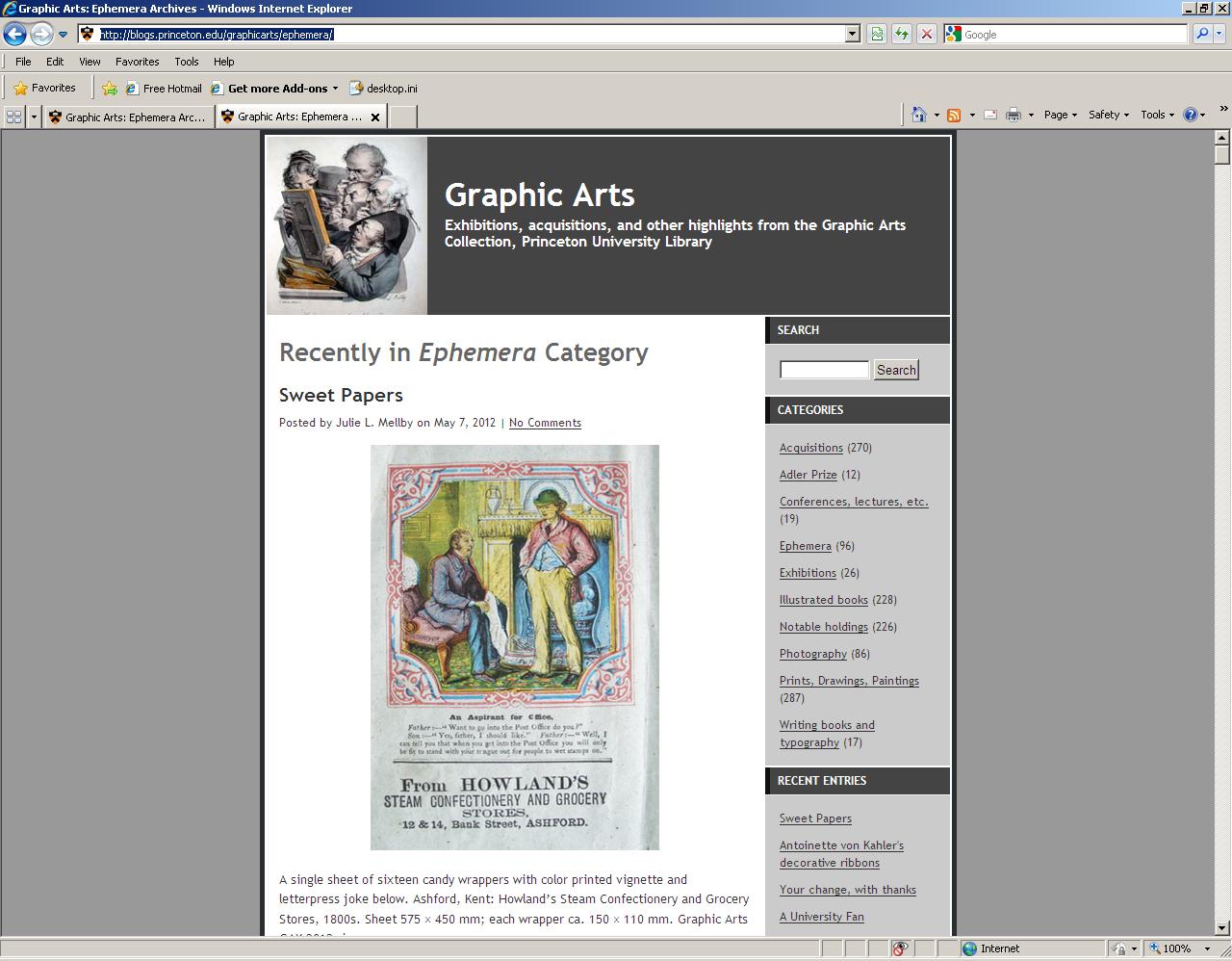
There is also a Princeton Graphic Arts Collection blog about Printed Ephemera (see screenshot), which focuses on individual items or groups of items from a wide range of ephemera, including games, rewards of merit, advertising, tobacco papers, Louis Prang, a tinsel print, dance cards, a magician, colouring of photograph and lantern slides, a sheet music cover, change packets and, most recently, sweet papers. There are 96 posts in all, so much to savour.

© 2012 The Trustees of Princeton University


Thursday, 26 April 2012

Folger Library Digital Image Collection

I briefly visited the Folger Shakespeare Library a few years ago and was delighted to see exhibited an array of fascinating Shakespeare playbills, many British but some for performances in the United States.

Those ephemera which have been digitised are online through Luna. I searched for Playbill (49 results).

Copyright © Folger Shakespeare Library®
Ephemera collections, scrapbooks and playbills are not included in the Folger's online catalogue, Hamnet, but there is an online finding aid to Garrick playbills (552 items).

There is also a fascinating blog post about the conservation of tinsel prints.


Wednesday, 25 April 2012

The Library of Congress: Performing arts posters and Shakespeare


There is much to explore for the ephemerist in the Library of Congress Prints and Photographs online catalog.
For this series on theatre and entertainment (for Shakespeare week), I will confine this post to the 2114 performing arts posters. These include theatre, magic and minstrels and can be browsed as a list (with thumbnails), a gallery, a grid (as in the screen shot) or as a slide show or searched.  Searching is aided by helpful drop-down lists: a search for opera, for example, prompts opera houses, opera bouffe, opera Normandy, etc as well as operas and operatic.

(C) Library of Congress, Prints and Photographs Division


There are hits for Shakespeare, of course, and additionally the Library of Congress has a special section in its Imagination Gallery (part of American treasures) devoted to Shakespeare in America, which includes ephemera.

Friday, 20 April 2012

Seed catalogues 3: The US National Agricultural Library

The National Agricultural Library (United States Department of Agriculture) has, within its Special Collections, a major collection of seed catalogues: The Henry G. Gilbert Nursery and Seed Trade Catalog Collection. There are 200,000 catalogues, from America and a wide range of other countries (including Britain), mostly from 1890 to the present but with some dating back to the late 18th century. The image gallery presents selected covers of catalogues from the US by period (1750-1875, 1876-1900, 1901-1925) and from Japan, mostly from the Yokohama Nursery Co,. Ltd.

(C) National Agricultural Library (United States Department of Agriculture)

The Library also has a collection of posters relating to the Women's Land Army, War, Rural Electrification Administration, and the World's Poultry Congress.

Wednesday, 18 April 2012

Seed catalogues 1: Oregon State University Libraries

It is National Gardening Week, and this seems a very good time to focus on seed catalogues.

Oregon State University Libraries Special Collections has a very useful and well presented online exhibit on early seed catalogues, based on the collection assembled by the former agricultural librarian, Laura Kelts. There are over 2,000 items in the collection, from 1832 to 1966, which include seed catalogues from Great Britain, Holland and other European and Asian countries, as well as (predominantly) North America. The holdings are particularly strong in North American catalogues of the 1940s.

The website gives the history of both British and American seed catalogues. It is divided into pages on the Earliest European seed and nursery catalogues, Early 19th century catalogues (with separate pages for British and American catalogues, Mid 19th century,  Late 19th and early 20th century, World War I, 1920s, 1930s, World War II and 1945-1960.  The appendices are devoted to Art and photography in seed catalogues and, perhaps most useful of all, there is an excellent page of links to other collections and exhibits, mostly in the USA, but also in Britain, Holland and Canada and introducing the Lindley Library (Royal Horticultural Society) project to locate all European seed catalogues, and a separate Bibliography.  Which is why I have called this Seed catalogues I: there is much more to explore!

Friday, 13 April 2012

Library of Congress WPA posters

An American phenomenon, WPA (Work Project Administration) posters make a fascinating comparison with contemporary British poster style. The WPA website of the Library of Congress contains 932 posters of the 1930s and 1940s, which can be searched, browsed or viewed as a slide show.

The posters were a government intiative and were "designed to publicize exhibits, community activities, theatrical productions, and health and educational programs in seventeen states and the District of Columbia, with the strongest representation from California, Illinois, New York, Ohio, and Pennsylvania."

The images are accompanied by full metadata, including detailed iconographic indexing. Subjects include exhibitions, books, concerts, shows, and health and safety.

(C) Library of Congress

Tuesday, 10 April 2012

Motoring ephemera: Taking the wheel at the NYPL and the John Johnson Collection's Toyota Project

Taking the wheel (from the NewYork Public Library's Digital Gallery) with its 804 images, 'offers a sampling from the year 1909 of the Science, Industry and Business Library's (SIBL) extensive collection of manufacturers' catalogs and price lists'. The entire collection numbers c. 8,000 items and covers the first three decades of the 20th century.  Other forms of transport, dating back to the 17th century, are represented in the Library but have not been systematically digitised.

The context of these 1909 images can also be searched in Related subjects, from ambulances, through opera houses to working dogs.  I loved the view of the chauffeur-driven Lorraine DiĂ©trich in front of the Paris Opera House.
(C) New York Public Library


The Toyota Project (1996) was the Bodleian Library's first digital project.  All motoring material was indexed and digitised, together with a further 1,000 images representing the other Transport sections of the Collection.  Every page of every catalogue was scanned, but OCR was then in its infancy and the results were poor and attempts to provide full-text searchability had to be abandoned.  Keyword searching has been applied to the data (only).


(C) Bodleian Libraries: John Johnson Collection


The 1244 items, (570 Motoring ephemera, the rest other forms of transport) can be seen as thumbnails and medium and large images.
 

Thursday, 5 April 2012

Women working: trade catalogues at Harvard

Available through the Harvard University Library Open Collections Program, Women Working, 1800-1930 includes (as well as books and pamphets, diaries and memoirs, institutional records, magazines, manuscripts, and photographs) 6,000 pages of materials from from 155 trade catalogs and pamphlets from 70 companies.

©2012 The President and Fellows of Harvard College
 Dating from 1870, the trade catalogues are divided into the following subject sections:
The trade catalogues are beautifully digitised in full colour. The text can be both viewed and searched (uncorrected OCR).  Related links (from individual catalogues) take the user to the full catalogue record on HOLLIS (the library catalogue for Harvard University) and to relevant external sites, where appropriate. There are also Teacher Resources, arranged by theme and a Timeline.

Patent medicine cards at UCLA

UCLA Library digital collections includes 247 Patent Medicine cards (1870 to c. 1906) from the Louise M. Darling Biomedical Library. History and Special Collections for the Sciences. These which can be browsed by language (almost exclusively English), name and subject.  Detailed metadata can be seen by clicking on the title. This also brings up a Zoomify function (which wasn't working when I tried it).

Thumbnails can be seen by clicking on the Patent Medicine cards main title or by selecting brochures, still images or trade cards under Type: still images and trade cards (genre) are applied to most of the material to enable cross-searching with other collections.   The beta viewer requires a specific term, but then allows panning of the image.

(C) UCLA