Showing posts with label blogs. Show all posts

Tuesday, 18 December 2012

Australasian Ephemera - Part 2: Australia. Guest post by Anthony Tedeschi

Very many thanks to Anthony Tedeschi for his second post about Australasian ephemera and to Richard Overell of Monash University for supplying images from their collections. Anthony's own blog: Antipodean Footnotes gives fascinating insights into rare books and special collections in New Zealand and Australia.


Australasian Ephemera Collections – Part 2: Australia

Following on from my guest post in October on New Zealand ephemera collections, the second of this two-part post highlights some of the ephemera collections held by Australian institutions. Like the New Zealand post it is hoped additions will be made by way of comments.

For details on the various subject categories collected, it is suggested interested readers consult each institution’s on-line catalogue (subject search ‘ephemera’). A Directory of Australian Ephemera Collections was published by the State Library of New South Wales in 1992. An Index, compiled by the State Library of Victoria, was published the following year.

(C) Monash University: special collections


The AIATSIS began collecting ephemera in the 1970s. Starting out with a focus on print material, the collection has grown to include non-paper items, such as badges, t-shirts, and tea towels. The largest sequence in the collection is comprised of invitations to openings of Indigenous art exhibitions from across Australia.

A PDF summary of the collection and index to the ephemera categories is available (see link above).

The AWM finding aids page includes links to multiple guides from aerial photographs and card, certificates and leaflets, to private records and film and sound. Though many of the guides pertain to ephemeral material, such as the Guide to the Cigarette & Trade Card Collection, under the specifically named ‘Ephemera (includes cards, certificates, leaflets, postcards and souvenirs)’ heading are listed: British Commonwealth Occupation Force Souvenirs Collection, Souvenirs 15, the Korean Collection, the Vietnam Collection, the Gulf War Collection, the East Timor Collection, the Iraq 2003 Collection, and the Afghanistan Collection.

Monash University Library 

(C) Monash University: special collections

Monash University special collections have been acquiring ephemera since the 1990s. Material in the collection dates from late seventeenth-century English pamphlets and broadsides to current menus, games, souvenirs, posters, flyers, cards, and junk mail. In 2011, the library hosted an exhibition called Ephemera, with a catalogue (PDF) and on-line version providing an overview of its rich holdings.

The Monash collection featured on the John Johnson Collection’s Ephemera Resources blog on 6 February 2012.

(C) Monash University: special collections

Australia’s national library has been collecting ephemera relevant to the nation since the 1960s. The Australian ephemera is indexed and divided into seven themes by subject: Australian performing arts programmes and ephemera (PROMPT), formed collections, general ephemera, geography and travel, programmes and invitations, scrapbooks, and trade catalogues. While the NLA collects widely, it aims to acquire as much Federal election campaign material and material relating to national events as possible. In 2007, the NLA received the oldest example of Australian printing – the 1796 ‘Jane Shore playbill’ – as a gift from the Canadian government.

The NLA maintains a General Ephemera Collection Thesaurus (PDF). Readers might also be interested in the Library’s database Trove, which includes a number of ephemera related resources and collections listed among its contents from across Australia, some of which, such as the Federation Ephemera at the State Library of New South Wales project, are freely available on-line.

Visitors can browse the ephemera collection and read the Library’s ephemera collection development policy. The Library’s ‘Behind the Scenes’ blog has also recently added two posts on ‘canvassing election ephemera in the Pacific’ (Part 1 and Part 2).
 

Between the Mitchell and State Reference libraries, the SLNSW holds a diverse collection of ephemera, which includes some of the earliest examples in Australia. Among the individual pieces highlighted on the Library’s website are: a 1612 Dutch translation of the de Quiros pamphlet, which contains the earliest printed reference to the word ‘Australia’, a broadside ca. 1789 describing a wild man or monstrous plant brought from Botany Bay, a playbill dated 8 March 1800, propaganda leaflets dropped by a Turkish aeroplane at Gallipoli during World War I, and an album of invitations, menus and other ephemeral printing related to the Inauguration of the Commonwealth of Australia in 1901.

Among the subjects highlighted on-line are collections related to Qantas airline, which includes material from the 1920s to the present day, and on horse racing.

The John Oxley Library of the State Library of Queensland notes calendars, elections, exhibitions and festivals, invitations, menus, royalty and royal visits, sport, and trade programmes among the categories of material which it collections. The strongest sequence in the collection is the Library’s theatre programmes, which date from 1866 to the present day.

The John Oxley Library blog uploaded two helpful posts (available on the same page) describing its theatre ephemera and how to search the ephemera collection in the Library catalogue.

Material in the State Library of South Australia’s ephemera collection dates from 1836 onwards, and includes material similar in nature to many other institutions, from badges and business cards, to greeting cards and sheet music. The library, however, also holds a unique collection of wine labels. Collected since 1972, there are approximately 10,000 labels in the collection, reflecting the state’s connection to the Australian wine industry. A description of the collection can be found on the ephemera guide page (see link above), and two hundred and fifty labels have been digitised and are available through the Library’s Wine Literature of the World website.

Centred on ‘Victoria and Victorians’, but including material from across the country as well, the State Library of Victoria holds one of the largest ephemera collections in Australia. Material dates from the 1850s onwards. In addition to the types of ephemeral material held by other institutions, the SLVA is busy building a collection of local zines to document Melbourne’s thriving art and music scenes.

Three of the library’s major ephemera collections – advertising, political ephemera, and theatre programmes – have individual descriptions. Some examples from the Library’s ephemera collection have been digitised, such as the fan-shaped programme for the play School for Scandal (Melbourne, 1869) and the 1935 Myer Mail Order Shoppers’ Guide for Autumn & Winter. There is also a research guide to the Library’s Political Ephemera Poster Collection. A number of the posters have also been digitised and are available on-line.

The SLWA ephemera collection numbers over 100,000 items. The library maintains a selection of highlights from its ephemera collection on topics such as ships and shipwrecks in Western Australia, royal visits, firms and businesses, the Festival of Perth, and a collection of tombstone inscriptions gathered from Western Australian cemeteries. There is also a page dedicated to finding Indigenous ephemera.

University of Queensland
While I could not find a general summary of its ephemera collection, the University of Queensland Fryer Library has highlighted some aspects of the collection, such as political ephemera and material marking Queensland statehood, as part of its Treasure of the Month on-line exhibition series.


Part of the Sir George Grey Special Collections, the ACL Ephemera Collection includes material from the 1840s onwards divided into three distinct collections: the Old Colonists’ Museum Collection (material on Auckland’s colonial period given to the library when the OCM closed in the 1950s), the Freida Dickens Programme Collection (music, dance and theatre programmes, 1911-1976), and the New Zealand Ephemera Collection, which is divided into two sequences based on type and subject matter respectively (material includes menus, tickets, advertising flyers, cards and calendars).

The library maintains a searchable ephemera index database.

----

Wishing everyone Happy Holidays and a joyous New Year from the Antipodes!

[Guest post by Anthony Tedeschi, Rare Books Librarian, Dunedin City Library]

Tuesday, 12 June 2012

Cartoon Archive Rapid Digitisation (CARD)

Last year The British Cartoon Archive at the University of Kent's Templeman Library undertook a JISC-funded rapid digitisation project (CARD) which included not just cuttings of cartoons but also the notorious saucy seaside postcards by Donald McGill, from the Director of Public Prosecution's Archive. There is a CARD blog by Nicholas Hiley, Head of the British Cartoon Archive.

There are 389 postcards (excluding the DPP cards) on the BCA site by Arnold Taylor, Douglas Tempest, David Low, Giles, etc. as well as Donald McGill, and by publishers D. Constance Ltd, Bamforth and Co, Evening Standard, Daily Express, and Daily Mirror.  Many of the 1,324 prosecution cards (for cards by various artists) are in copyright and therefore have no image files but the 254 for McGill are online.  There is an index to the abbreviations used by the DPP.

The BCA catalogue also has 895 entries for poster (published in newspapers) and 1,568 for advertisement, mostly newspaper cartoons satirising advertising. The Advanced search includes a drop-down menu for searches by format: there are 265 menus (covers and artwork), 163 Christmas cards, for example. A fascinating insight into another ephemeral view of the world.

(C) British Cartoon Archive, Templeman Library, University of Kent

Monday, 11 June 2012

About postcards

The blog About postcards, a reference resource for postcard collectors is an invaluable source of information on postcard genres, artists and themes by postcard dealers and enthusiasts Linda and Peter Chapman. Illustrated from their own collection, the tagged blog posts have built up into a multi-layered tool for all who are interested in postcards or in the very many subjects they illustrate. Above all the posts provide context -  for an isolated card from a series or an example of an artist's work, etc.

There are really nice features: a search brings up a little results box with thumbnails and sentences extracted from the posts containing the relevant term hit-highlighted (as in the screen shot).  The posts themselves can be viewed classically (chronologically) or as a mosaic (of images with titles which appear when moused over) or as flipcards. It is a site which is fun to dip into for fascinating snippets of information but is also a serious research tool. One of the JJ volunteers found the site while cataloguing South African War postcards.

There is also a glossary of postcard terminology.

(C) About postcards


Wednesday, 9 May 2012

Princeton University Special Collections

There is a really useful online guide to selected special collections at Princeton University Library.

Alphabetically arranged, it gives a description under each heading. The entry under Ephemera highlights printers' samples, playbills, ballads, a World Columbian Exposition scrapbook, and proofs of labels for the Dutch linen trade.  There are also separate entries for Bookplates, Broadsides, Dust-jackets (Hodder and Stoughton, c.1900-1940), Lantern slides, Phrenology, Poetry broadsides, and Prospectuses.

A text search for ephemera of the Princeton University Library website brings links to Latin American posters, Grabhorn ephemera, to the Edward Naumburg Tea ephemera collection listing, to the Cotsen Collection and much else.

The Cotsen Collection (which I was priviledged to visit last year for the ephemera conference: Enduring trifles) is principally a distinguished collection of children's books, but contains ephemera and the Webb Miniature Theatre archive, with the original printing plates and stones.

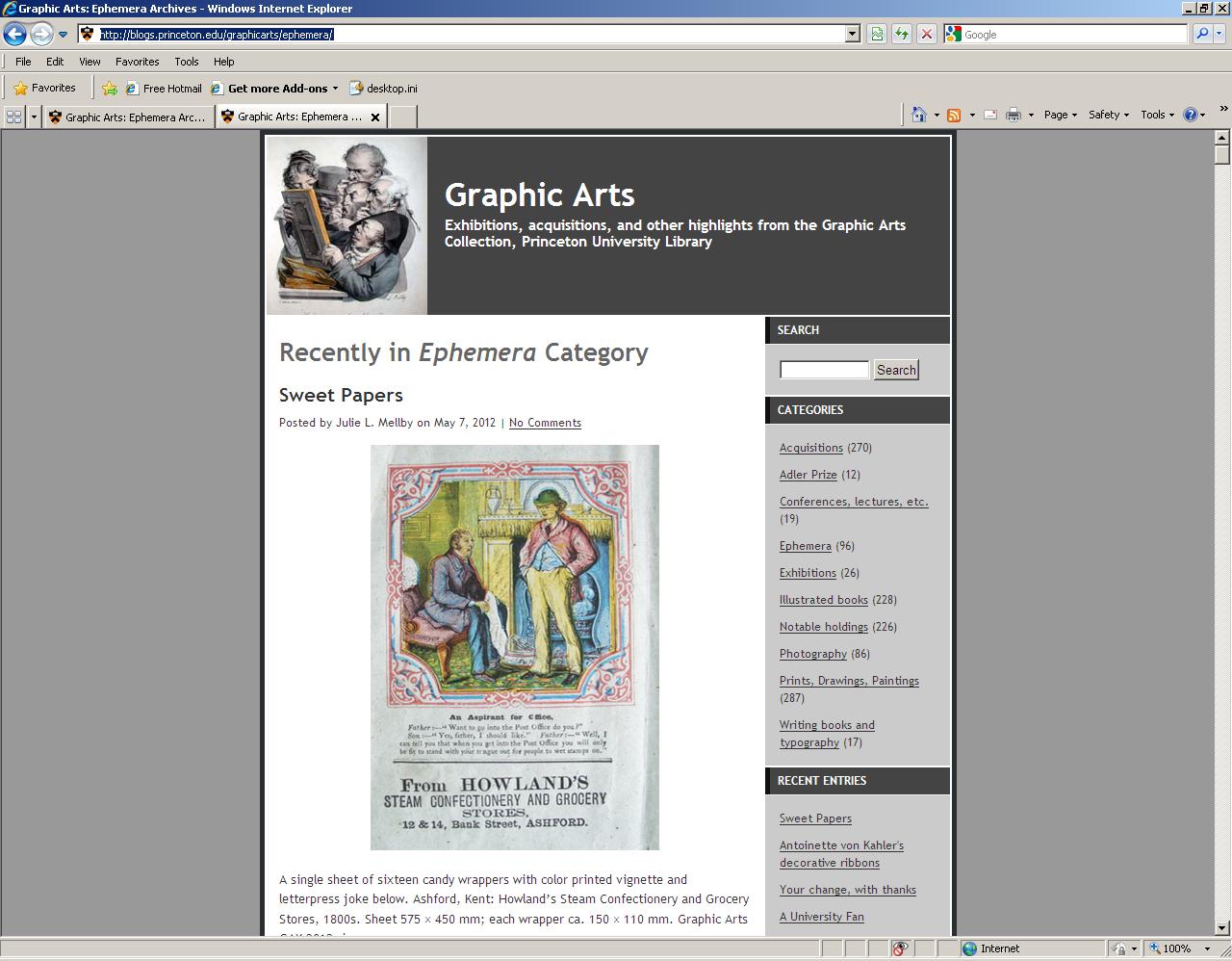
There is also a Princeton Graphic Arts Collection blog about Printed Ephemera (see screenshot), which focuses on individual items or groups of items from a wide range of ephemera, including games, rewards of merit, advertising, tobacco papers, Louis Prang, a tinsel print, dance cards, a magician, colouring of photograph and lantern slides, a sheet music cover, change packets and, most recently, sweet papers. There are 96 posts in all, so much to savour.

© 2012 The Trustees of Princeton University


Tuesday, 21 February 2012

The Wellcome Library

The Wellcome Library includes 43,000 16th-21st century ephemera relating to the history of medicine. This material is being surfaced through the Wellcome Library's online catalogue, through a blog (tag Ephemera)  and through Wellcome Images, where tags include advertisements and ephemera. Where they exist, full bibliographic records from the library catalogue are linked to images in Wellcome Images. Thumbnails appear in the corresponding catalogue entries.  Only c.10 per cent of the ephemera are fully catalogued, with box level records for the rest. Enquiries should be directed to library@wellcome.ac.uk.

Useful search terms for genres relevant to ephemera (select genre/medium in library catalogue search) are:

Addresses, Advertisements, Advertising cards, Advertising fliers (div by century), Albums, Almanacs, Auction catalogues, Badges, Bags, Ballads, Billheads, Blank forms, Blotting paper, Book covers, Bookmarks, Bookplates, Books printed as advertisements, Booksellers advertisements, Broadsides (subdiv geog & chron), Cards, Calendars, Cartes de visite, Cartoons (commentary), Catalogues, Certifcates, Christmas cards, Cigarette cards, Concert programs, Cut paper works, Cutouts, Devotional images, Direct mail, Display cards, England broadsides, Envelopes, Ephemera, Exhibition catalogues, Exhibition posters, Gameboards, Greetings cards, Handbills, Handkerchiefs, Invitations, Jigsaw puzzles, Keys (legends).Labels, Lantern slides, Leaflets, Letterheads, Library catalogues, Lottery tickets, Magazine inserts, Manufacturers catalogues, Membership cards, Membership lists, Menus, Motion picture posters, Optical toys, Packaging, Panoramic views, Paper toys, Photographic postcards, Pictorial envelopes, Playing cards, Postage stamps, Postal stationery, Postcards, Posters, Price lists, Proclamations, Programs, Prospectuses, Protest posters, Publishers catalogues, Puzzles. Raffle tickets, Rebuses, Regulations, Sales catalogues, Sheet music covers, Souvenir programs, Stationery, Stickers, Theater programs, Theatrical posters,  Tickets, Trade cards, Trade catalogues, Transfer sheets, Transparencies, Valentines, Visiting cards, Wall charts, War posters,  and Window cards.

Wellcome images also has a Facebook page and can be followed on Tumblr, Flickr and on Twitter (@wellcomeimages).

© Wellcome Images / Wellcome Library, London
.

Tuesday, 31 January 2012

The Ephemera Network

The Ephemera Network is a "community site for anyone and everyone interested in ephemera". Members (currently 691 of them) can sign up to groups with specific interests, such as Trade catalogues, Games, Billheads and Letterheads, or Stereoview cards. There are 69 groups, from Advertising cookbooks to World War 2 Games and Puzzles. The aim is for like-minded people to connect with each other. Non-members can see comments but cannot comment themselves.  There are several tabs, including Blogs, Events, and Discuss.  It is an excellent site for encouraging and supporting amateurs, collectors and those new to ephemera, and contains some fascinating information (including lengthy posts about specific genres or subjects) and links to other sites and blogs.

(C) The Ephemera Network. 2012, Created by Mike Ferguson

Monday, 30 January 2012

Railway posters at the National Railway Museum

The National Railway Museum in York has put 10,707 records for its posters online, many with associated digitial images. These can be filtered by railway company or cross-searched with other material through the search box on the Collections page. The screen shot shows a results for National Caledonian Railway.

C) National Railway Musuem


There are also 4,444 catalogued entries (not all digitised) associated with Using the railways (postcards, tickets, passes, labels, toys, etc) which can be limited by category and railway.

Users are invited to upload their own images to a Flickr site associated with the Museum.

There is also a fasinating blog about the work of the Museum -  from library and archive collections, to railway vehicle collections or conservation. I particularly enjoyed reading the blog by Lorna Frost about the conservation of paintings for the recent Art in Advertising exhibition.

The Museum is represented on many social media: YouTube, Twitter, Flicker, Facebook and Delicious.

Monday, 19 December 2011

Tinsel prints in the Museum of London

The Museum of London has just put its tinsel prints online, in time for Christmas. As well as some 250 prints (not all digitised), there are printing plates, stock sheets and dies (used for stamping the metal pieces). A blog post shows examples of the prints, and explains the process of creating tinsel prints.
The prints themselves often show actors in specific roles, so are important sources for theatrical history. The metallic foil was often used for characters in combat (shields, swords, helmets, etc).

Thursday, 17 November 2011

Museum of London

The Museum of London has wonderful collections of ephemera and is actively surfacing them, notably the tinsel prints, valentines, Christmas cards and trade cards.
The Collections pages enable you to read about the collections and to search (here I searched for suffrage).
(c) Museum of London

As well as the museum's website Ellie, the Project Assistant focussing on ephemera, is blogging regularly about progress.

The Museum's commercial site has thousands of images which can be searched and ordered.